
Search has changed dramatically — and if your marketing strategy hasn’t kept up, you’re already losing ground to competitors who have. At Art Unlimited, we work with contractors and home service businesses every day who are trying to make sense of a digital landscape that looks nothing like it did even two years ago. Traditional search engine optimization is no longer the only game in town. Answer engine optimization (AEO) and generative engine optimization (GEO) have entered the conversation, and understanding how all three work together is the key to staying visible, competitive, and profitable. This guide breaks down each approach, explains what sets them apart, and shows you how to use all three to corner your market in the age of AI search.
What Is SEO — and Is It Still Relevant?
Search engine optimization (SEO) is the practice of improving your website so it ranks higher in traditional search engine results pages (SERPs) like Google and Bing. It includes on-page factors like keyword use, content quality, and site structure, as well as off-page factors like backlinks and local citations. SEO has been the backbone of digital marketing for decades, and it remains essential today. Businesses that show up on page one of Google generate significantly more traffic, leads, and revenue than those buried on page two or beyond. Even as AI reshapes how people search, the foundational principles of SEO — experience, expertise, authority, and trustworthiness — carry directly into newer optimization strategies. SEO is not dying. It is evolving, and the businesses that adapt will come out ahead.
How AI Is Changing Traditional SEO
AI has shifted how search engines understand and rank content. Google’s Search Generative Experience (SGE) and other AI-powered tools now summarize information directly in search results, which means users sometimes get answers without ever clicking a link. For example, a homeowner searching “how long does a roof replacement take” may now see an AI-generated summary at the top of the page — pulling from multiple sources — before ever seeing a ranked link. This doesn’t make SEO obsolete — it makes quality content more important than ever. Search engines increasingly reward content that demonstrates real expertise, answers questions directly, and earns trust from other reputable sources. If your content is thin, outdated, or written purely for keyword stuffing, AI-powered search will pass right over it.
What Is AEO — Answer Engine Optimization?
Answer engine optimization (AEO) is the practice of structuring your content so it gets surfaced by answer engines — platforms like Google’s featured snippets, voice search, and AI assistants that pull direct answers from web content. When someone asks Siri, Alexa, or Google Assistant a question and gets a spoken answer, that answer almost always comes from a page that has been optimized for AEO. The goal of AEO is to become the source an AI or voice assistant cites when a user asks a question related to your business. For contractors and home service companies, this means your content needs to answer common customer questions in a clear, structured format that an AI can extract and present with confidence.
AEO vs SEO: What’s the Difference?
SEO focuses on ranking in traditional search results. AEO focuses on being the answer. With SEO, success looks like a high-ranking link — your HVAC company appearing on page one when someone searches “air conditioning repair Minneapolis.” With AEO, success looks like your content being read aloud or displayed as the definitive answer — Siri reading your FAQ response when a homeowner asks, “how often should I replace my air filter?” Featured snippets — the boxed answers at the top of Google results — are one of the most visible forms of AEO in action. Structured data (schema markup) plays a big role in helping search engines understand and extract your content accurately. Both strategies reinforce each other, which is why they work best when built together rather than in isolation.
How to Optimize Your Content for AEO
To show up as an answer, your content needs to directly address questions your customers are already asking. Use clear question-and-answer formatting, include FAQ sections, and write in plain language at or below an 11th-grade reading level. Structured data markup helps search engines categorize and extract your content. Short, authoritative answers followed by supporting details perform best. Think about the specific questions homeowners ask before hiring a roofing company, HVAC technician, or solar installer — then answer those questions better than anyone else on the internet.
What Is GEO — Generative Engine Optimization?
Generative engine optimization (GEO) is one of the newest concepts in digital marketing. It refers to the practice of optimizing your content so it gets referenced or cited by large language models (LLMs) like ChatGPT, Google Gemini, and Perplexity AI when they generate responses. When a user asks ChatGPT, “what should I look for in a roofing contractor,” the AI pulls from content it has been trained on or can access in real time. GEO is about positioning your brand as a credible, citable source within those AI-generated responses. Unlike traditional search, where rankings are clearly visible, GEO operates behind the scenes — making authority, accuracy, and consistency across your digital presence more critical than ever.
How LLMs Choose Which Sources to Reference
Large language models prioritize sources that demonstrate experience, expertise, authority, and trustworthiness — often called E-E-A-T in SEO circles. Think of it this way: if a homeowner asks ChatGPT, “is a metal roof worth the cost,” the AI isn’t pulling a random blog post — it’s drawing from sources that have consistently published accurate, well-sourced content and earned credibility across the web. Your Google Business Profile, industry citations, online reviews, and backlink profile all contribute to how AI systems perceive your brand’s credibility. Businesses that have invested in long-term content marketing and reputation management are already better positioned for GEO than those starting from scratch.
GEO Best Practices for Contractors and Home Service Businesses
Start by building a library of high-quality content that answers real questions your customers ask. Use your business name, location, and service categories consistently across your website, social profiles, and directory listings. Earn reviews on Google, and respond to them. Get cited by local publications, trade associations, and industry directories. These signals tell AI systems that your business is a legitimate, trustworthy source worth referencing. GEO is a long game, but the businesses that invest now will have a significant visibility advantage as AI search becomes the default way people find services.
SEO, AEO, and GEO: How They Work Together
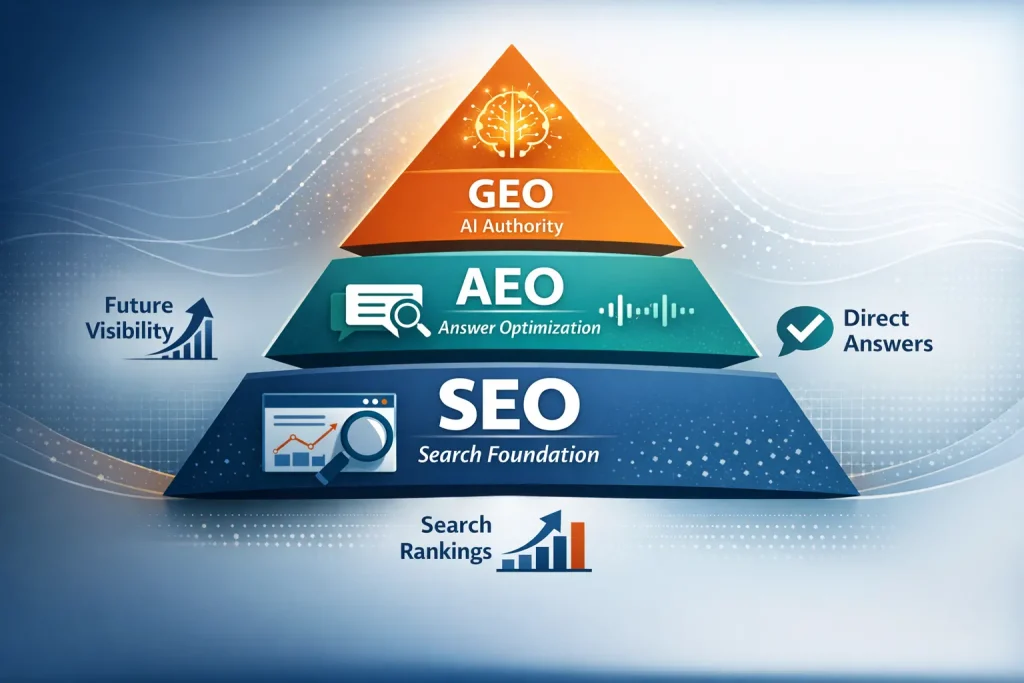
These three strategies are not competitors — they are layers of the same foundation. SEO builds your visibility in traditional search. AEO positions you as the answer to specific questions. GEO expands your reach into AI-generated responses that don’t come from traditional search at all.
Picture this: a homeowner needs a new roof. They Google “roofing companies in [city]” and find your site ranked on page one — that’s SEO working.
That same homeowner then asks Google Assistant, “what does a roof replacement cost” and your FAQ gets read back to them — that’s AEO.
Later, they ask ChatGPT, “what should I ask a roofing contractor before hiring them” and your blog post gets cited in the response — that’s GEO.
Neglecting any one of them leaves a gap that a competitor can fill.
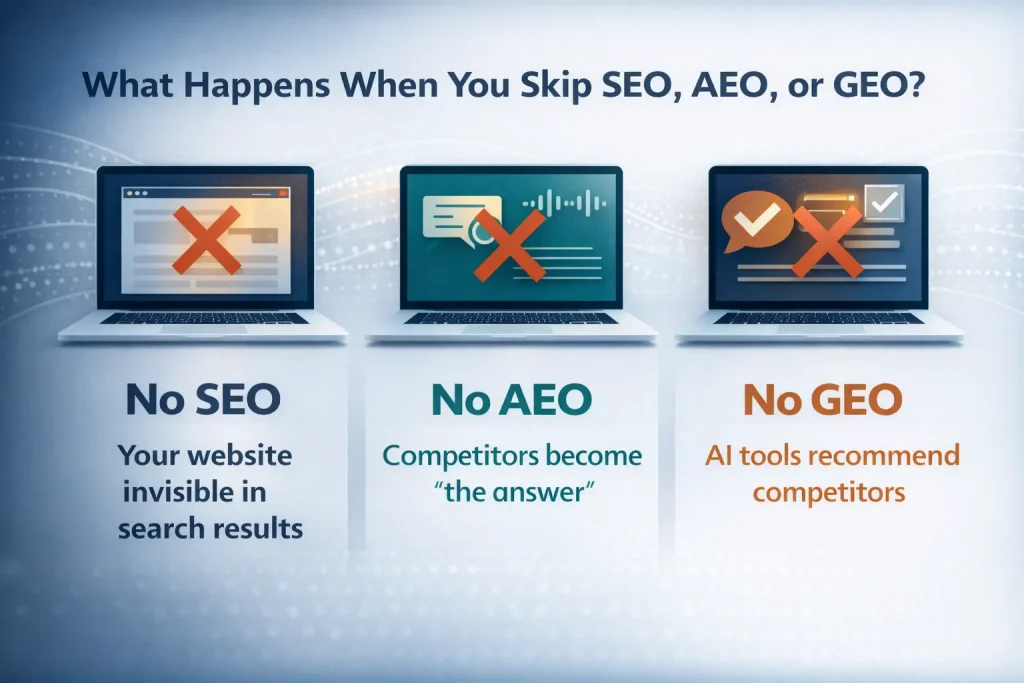
What Happens When You Skip SEO, AEO, or GEO?
Ignoring any one of these strategies has real consequences. Without SEO, your website sits invisible in search results while competitors collect the clicks, calls, and leads you should be getting. Without AEO, you’re absent from voice search and featured snippets — missing the growing number of customers who ask questions instead of typing keywords. Without GEO, your business won’t appear when AI tools like ChatGPT recommend service providers in your trade, handing that credibility to whoever invested in their content first. Each gap compounds over time. The longer these strategies are left unaddressed, the harder it becomes to catch up as competitors build authority and AI systems learn to trust their content over yours.
Which Should Businesses Prioritize?
For most small and mid-sized businesses in the trades, SEO remains the highest-ROI investment because it drives the most measurable traffic and leads. AEO should be built into every piece of content you create — it doesn’t require a separate strategy, just intentional formatting and question-focused writing. GEO is the most forward-looking of the three and becomes more important as AI search adoption grows. The smartest approach is to treat all three as interconnected: build content that ranks, answers questions directly, and establishes your authority as a trusted source across every platform where your customers are searching.
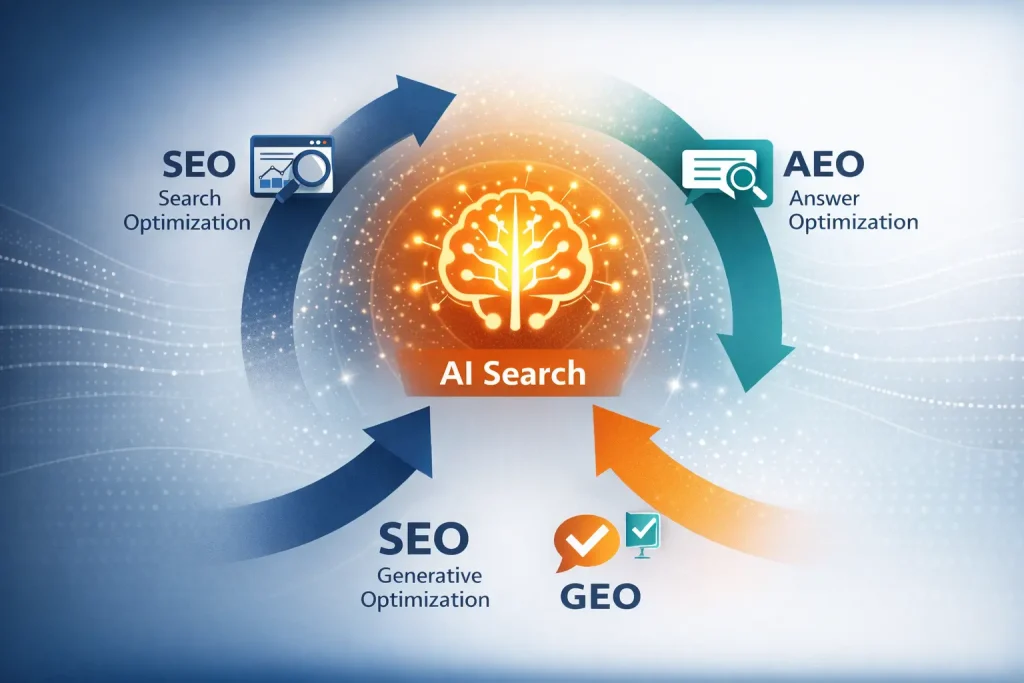
SEO vs AEO vs GEO: Side-by-Side Comparison
| Category | SEO (Search Engine Optimization) | AEO (Answer Engine Optimization) | GEO (Generative Engine Optimization) |
| Primary Goal | Rank higher in traditional search engine results (Google, Bing) | Become the direct answer in featured snippets, voice search, and AI assistants | Be referenced or cited inside AI-generated responses (ChatGPT, Gemini, Perplexity) |
| Where It Shows Up | Organic search listings, map packs | Featured snippets, voice search results, “People Also Ask” | AI-generated summaries and conversational AI responses |
| What Success Looks Like | Page one rankings and increased website traffic | Your content displayed or read aloud as the definitive answer | Your brand mentioned or cited in AI-generated recommendations |
| Core Focus | Keywords, backlinks, technical SEO, on-page optimization | Question-based formatting, structured data, clear direct answers | Authority, credibility, consistent brand signals, high-quality content |
| Key Ranking Factors | Relevance, backlinks, site structure, E-E-A-T | Structured content, FAQ schema, concise answers | Brand authority, online reputation, citations, consistent digital footprint |
| Time Horizon | Short- to mid-term measurable traffic growth | Mid-term visibility gains in featured answers | Long-term authority positioning in AI systems |
| Best For | Driving consistent, measurable leads and traffic | Capturing voice search and high-intent question queries | Future-proofing visibility as AI search adoption increases |
| Risk If Ignored | Invisible in traditional search results | Competitors become “the answer” instead of you | AI tools recommend competitors instead of your business |
Where Map Packs Fit in the AI Search Landscape
Most business owners are familiar with the map pack — the cluster of three local business listings that appears at the top of Google results when someone searches for a service in their area. What many don’t realize is that map packs are becoming even more important as AI reshapes search. Google’s AI-generated summaries now frequently pull from map pack listings to recommend local businesses, which means your Google Business Profile is no longer just a directory listing — it’s a direct input into AI-driven recommendations.
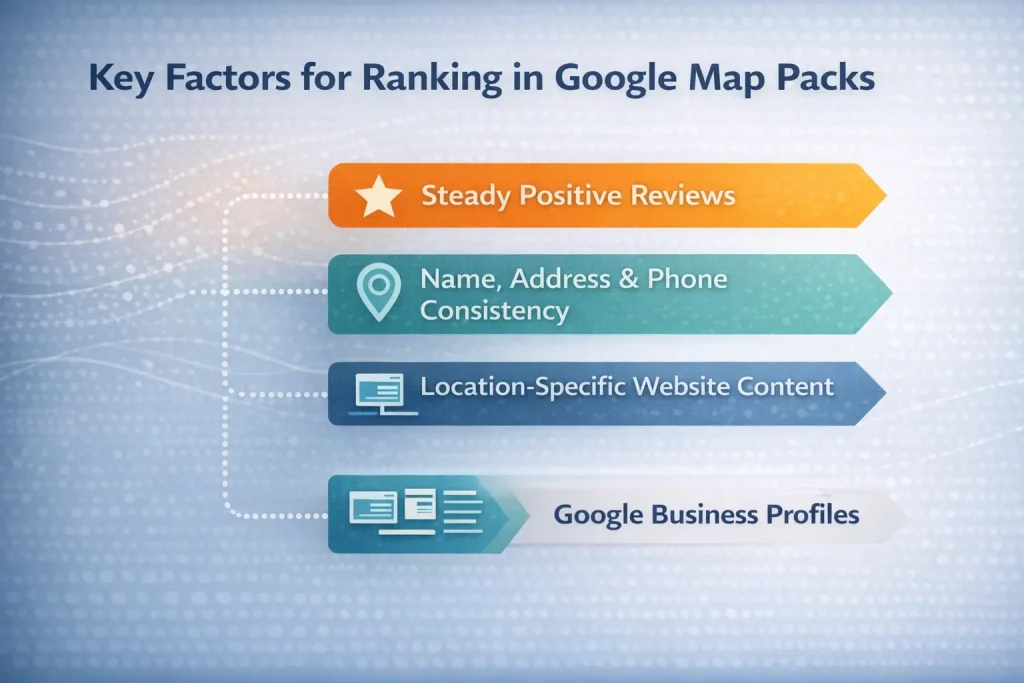
Why Your Google Business Profile Matters More Than Ever
When someone asks Google’s AI “who are the best roofers in [city],” the businesses that surface are those with complete, active, and well-reviewed Google Business Profiles. AI systems use the data from your profile — your business category, services listed, photos, review ratings, consistency of name, address, phone number, hours, and how frequently you respond to reviews — to determine whether your business is worth recommending. A neglected or incomplete profile is essentially invisible to these systems, no matter how strong your website content may be.
Map Packs, Local SEO, and AEO Working Together
Ranking in the map pack requires strong local SEO signals: consistent name, address, and phone number (NAP) across all directories, a steady stream of positive reviews, and location-specific content on your website. These same signals reinforce AEO and GEO by telling AI platforms that your business is legitimate, active, and trusted in your service area. For contractors and home service companies operating in specific regions, the map pack is often the first place a local customer sees your name — and increasingly, it’s the source AI tools draw from when making local recommendations. Keeping your profile updated and review-rich is one of the highest-impact actions you can take right now.
How a Structured Content Refresh Can Fix All Three
One of the most effective moves a business can make right now is conducting a structured content refresh across its entire website. This means auditing every page — service pages, blog posts, FAQs, and location pages — and updating them with current information, question-focused formatting, and consistent use of your business name, services, and location. A content refresh isn’t just about fixing old facts. It’s about realigning your entire site to meet the expectations of traditional search engines, answer engines, and AI platforms at the same time.
What a Content Refresh Actually Improves
When done systematically, a content refresh strengthens all three optimization strategies at once. Updated, well-structured pages give search engines fresh signals that improve rankings — that’s SEO. Adding FAQ sections and direct answers to common customer questions makes your content eligible for featured snippets and voice search — that’s AEO. Publishing accurate, authoritative content consistently across your site builds the credibility that AI tools look for when deciding which sources to reference — that’s GEO. One focused effort, three layers of visibility gained.
How to Approach a Site-Wide Content Update
Start by identifying pages that are outdated, thin on content, or missing question-based formatting. Prioritize high-traffic service pages and any blog posts that already rank but haven’t been updated in over a year. Add structured FAQ sections, sharpen your calls to action, and make sure your business information is consistent from page to page. For contractors and home service businesses, this often means revisiting service descriptions to include the specific questions customers ask before picking up the phone — and answering them clearly. A methodical, page-by-page approach delivers far better results than sporadic updates with no strategy behind them.
Future-Proofing Your Search Strategy
Traditional search engines are not disappearing anytime soon, but the way people use them is shifting fast. Voice search, AI assistants, and generative AI tools are changing where people go to find answers — and more importantly, which businesses get recommended. The companies that will thrive are those that build deep libraries of authoritative, helpful content rather than chasing algorithm shortcuts. Investing in SEO, AEO, and GEO now is how you protect your visibility regardless of what changes next. If you’re not sure where your current strategy stands or which gaps need to be filled, that’s exactly the kind of challenge Art Unlimited was built to solve. We can audit your existing content to see how it performs across SEO, AEO, and GEO — identifying what’s working, what’s missing, and where your biggest opportunities are. Connect with our team and let’s build a search strategy that puts your business in front of the right customers — wherever they’re searching.